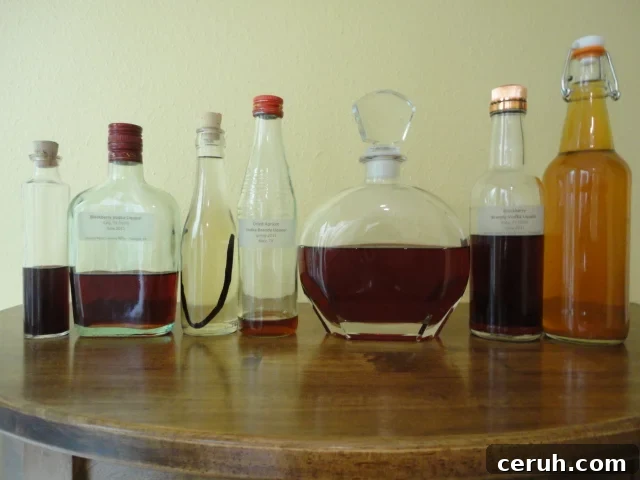
Homemade Liqueurs (L-R) Blackberry (whisky), Blackberry (vodka), Vanilla Bean (grain), Dried Apricot (vodka-brandy), Blackberry (vodka-brandy), Apple (grain-vodka)
Why make your own liqueurs or cordials? Simply put: because you can, and it’s enjoyable. The method is straightforward; the hardest part is patience. Homemade liqueurs are a rewarding kitchen project that combines creativity, tasting, and a little chemistry.
The precise origins of liqueurs and cordials are debated, but most historians agree they emerged in Europe during the 13th and 14th centuries. Early cordials were herbal infusions in spirits used for medicinal purposes, and sweeteners such as sugar or honey were added to make the mixtures easier to take. Over time the terms cordial and liqueur became interchangeable, although some U.S. jurisdictions still use sugar content to distinguish them. Generally speaking, a liqueur differs from wine or straight spirits because a sweetener is added; dessert wines rely on naturally occurring sugars, and flavored spirits may be infused without added sugar. Typical liqueur alcohol by volume ranges from about 15% to 30%, though some reach 55% ABV.
Making liqueurs at home requires only a few basic items: a large glass container to hold the ingredients, a spirit for infusion, a sweetener, filtration materials (coffee filters and a funnel work well), and bottles for storage. The process is forgiving and adaptable: choose a spirit and flavoring agent, combine them, wait while the flavors infuse, filter, sweeten to taste, and bottle.
My earliest attempts taught me how subtle or bold results can be. The first batch, made with persimmons in October 2010, yielded a lovely color but lacked strong flavor. A cranberry batch that followed produced better flavor, though some tasters found it too boozy and not sweet enough. Other experiments brought both hits and misses: a ginger liqueur I made in November 2010 tasted medicinal to me, though some friends enjoyed it. Fresh fruit usually gives the most satisfying results—blackberries in particular have been consistently successful—while dried fruits like apricots make excellent liqueurs when combined with vodka and brandy.
Over time I’ve learned a few practical lessons. Not everyone will like every liqueur you make—tastes vary widely; some prefer very sweet liqueurs, others much drier. Patience is essential: many liqueurs improve significantly with time, allowing their flavors, aromas, and colors to develop and meld. It’s easy to get carried away experimenting and make either too much or too little. Start with manageable batches so you can refine recipes and keep plenty on hand for friends who ask for refills.
So far I’ve made several varieties: persimmon (vodka), two cranberry batches (vodka), two dried apricot batches (vodka-brandy), blackberry in vodka and in vodka-brandy, vanilla bean in grain spirit, and apple in grain-brandy. Each taught me something about balance, infusion time, and sweetening.
Turning spirits, fruit, and sugar into a well-balanced liqueur is a delightful, grown-up science experiment. If more school science had followed this model, it might have persuaded a few more students to appreciate chemistry and flavor.