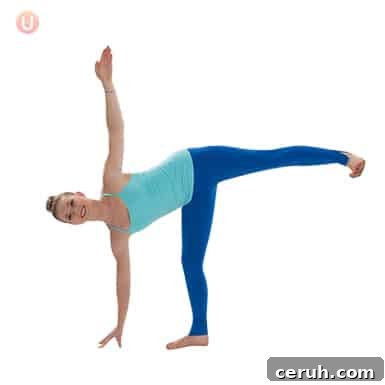
Balancing Half Moon is an advanced standing balance pose that builds strength, stability, and alignment. It challenges your coordination while strengthening the legs, hips, and core, and it opens the chest and lengthens the spine. For students ready to deepen their balance practice, learning Balancing Half Moon offers both physical and mental benefits: improved posture, increased proprioception, and a calmer, more focused mind.
Beginners often find balance poses difficult. Balancing Half Moon can feel especially challenging at first because it requires single-leg support, hip rotation, and shoulder stability all at once. Fortunately, there are clear, effective ways to approach the pose so you can progress safely and confidently.
Start with props. Place a yoga block, low stool, or chair in front of you so the hand that reaches toward the floor has a higher, more stable contact point. This reduces strain and makes balance easier to manage while you learn the alignment. Another effective method is to practice with your back or side near a wall. Using the wall gives you a reliable reference for balance and body positioning, allowing you to focus on creating length through the spine and stacking the hips and shoulders correctly. Once the position feels more secure, gradually move away from the wall or lower the block until you can balance with the hand on the floor.
Core engagement is essential in all balance poses, and Balancing Half Moon is no exception. Before you lift your leg, draw the lower belly in toward the spine to create a strong, steady foundation. Keep that engagement as you extend the lifted leg and open through the torso. The core keeps the pelvis stable and helps prevent collapsing through the standing side.
Alignment matters more than how high you lift your leg. Aim to “stack” joints vertically where possible: the lifted shoulder above the standing shoulder and the lifted hip above the standing hip. This stacking helps distribute weight evenly and reduces wobble. The lifted hand points toward the sky, the gaze can lift gently toward that hand, and the neck remains long and relaxed. Micro-adjustments in the standing foot and ankle—pressing evenly through all corners of the foot—will also improve stability.
Balancing practice benefits more than physical balance; it improves concentration and body awareness. Regular practice of Balancing Half Moon can translate into better balance in daily activities and contribute to long-term functional independence.
How to Perform Balancing Half Moon Pose
- From a steady standing position, inhale and reach both arms overhead to lengthen the spine and find your center.
- Exhale and hinge forward from the hips, folding over the standing leg while keeping a long spine. Place both hands shoulder-width apart on the floor or on a block.
- Shift your weight onto the standing leg and begin to lift the opposite leg straight back. Keep the lifted leg active, toes pointed or flexed to engage the muscles.
- Slowly rotate your torso to the side and lift the top arm toward the sky, turning the chest open. Keep the hand closest to the floor pressing into the mat or block for support.
- Work to stack the top shoulder over the bottom shoulder and the top hip over the bottom hip. Soften the standing knee slightly if needed to maintain balance and avoid locking the joint.
- Gaze can follow the lifted hand or remain neutral at a fixed point to steady the balance. Continue to breathe evenly and keep the core engaged.
- Hold the pose for about 30 seconds or for a few steady breaths, then gently lower the lifted leg and return to standing. Repeat on the other side.
Modifications and tips: use a block at different heights to find the level that is most supportive, practice next to a wall for extra confidence, and try holding onto a chair back if you need more stability. Avoid forcing the lifted leg or rotating beyond your comfortable range; instead, focus on alignment and steadiness. If you have recent ankle, hip, or lower-back injuries, consult a qualified teacher or healthcare professional before attempting this pose.
With consistent, mindful practice, Balancing Half Moon becomes more accessible. Be patient with progress, prioritize safe alignment, and celebrate small improvements in strength and balance. Over time, you will notice better posture, improved coordination, and increased confidence in one-legged balance — benefits that extend well beyond the mat.